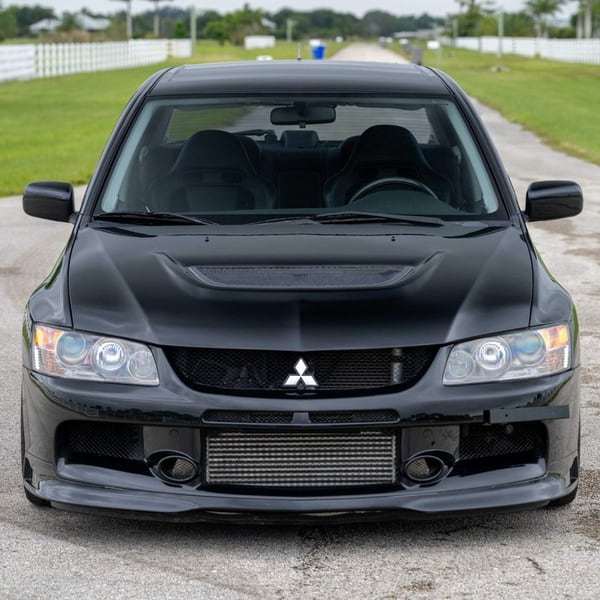
Evo 8 vs Evo 9 comes down to one engine in two states of tune and one drivetrain change. The Evo 8 made 271 hp in 2003 and 276 hp by 2005, and the Evo 9 made 286 hp with MIVEC variable valve timing. Every Evo 9 has the Active Center Differential, which only the 2005 Evo 8 has. The Evo 9 is the rarer car and costs more.
Evo 8 vs Evo 9: the differences that matter to a buyer
Evo 8 vs Evo 9, side by side: MIVEC and 286 hp, the Active Center Differential, the body changes, the counts and today's prices.
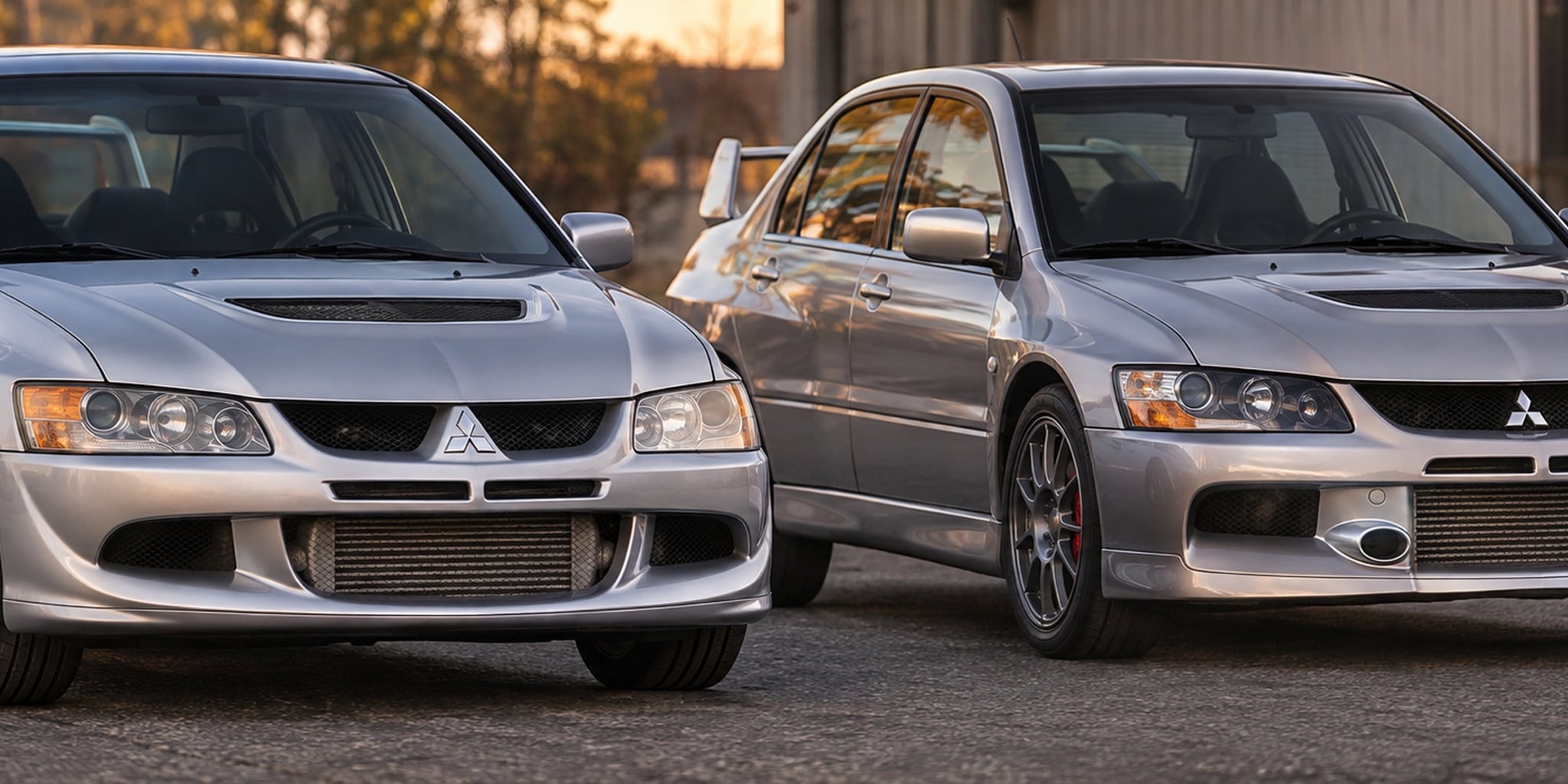
An illustration made for this article. Illustration made with ChatGPT, not a photograph
271 hpEvo 8 power2003 and 2004
286 hpEvo 9 power2006
MIVECAdded on the Evo 9Intake cam only
12,846Evo 8s for the US2003 to 2005
8,201Evo 9s for the US2006, per Hagerty
At a glance
Evo 8 vs Evo 9 differences at a glance
The two cars share a chassis code, CT9A, and the 4G63 engine. The Evo 8 vs Evo 9 differences are in how that engine breathes, how the center differential works, and a set of body and cabin changes.
| Evo 8, 2003 and 2004 | Evo 8, 2005 | Evo 9, 2006 | |
|---|---|---|---|
| Power | 271 hp | 276 hp | 286 hp |
| Torque | 273 lb-ft | 286 lb-ft | 289 lb-ft |
| Valve timing | Fixed | Fixed | MIVEC, intake |
| Center differential | Viscous coupling | Active, ACD | Active, ACD |
| Six-speed MR | No | Yes | Yes |
| US cars built | 7,167 and 1,517 | 4,162 | 8,201 |
The build counts are Mitsubishi Motors North America's figures as recorded on Wikipedia for the Evo 8, 7,167 for 2003 and 1,517 for 2004, and Hagerty's figure for the 2006 Evo 9.
The engine: 271 hp, then MIVEC and 286 hp
The Evo 8 arrived with 271 hp at 6,500 rpm and 273 lb-ft at 3,500 rpm. For 2005 Mitsubishi raised that across the line. Its announcement of October 18, 2004 says horsepower increased "from 271 to 276 hp," with 286 lb-ft of torque at 3,500 rpm.
The Evo 9 added MIVEC, Mitsubishi's variable valve timing, on the intake camshaft only. Mitsubishi's launch material says the engine, with "enhancements to the vehicle's turbocharger, produces higher torque and better response," and gives the output as 286 horsepower at 6,500 rpm and 289 lb-ft at 3,500 rpm. The five-speed gearbox also got new ratios to suit.
271 hpEvo 8, 2003
276 hpEvo 8, 2005
286 hpEvo 9, 2006
On paper the gain from the first Evo 8 to the Evo 9 is 15 hp and 16 lb-ft. The larger difference is where the torque arrives, since MIVEC lets the engine fill in below the turbo's peak. Our 4G63 engine article covers the engine in both forms.
The drivetrain: when the Active Center Differential arrived
This is the difference that splits the Evo 8 itself. The 2003 and 2004 cars use a center differential with a viscous coupling, a passive unit that reacts to slip. MotorWeek described it in 2003 as "a twin-differential driveline, with a viscous coupling to adjust power distribution."
For 2005 the Evo 8 gained the Active Center Differential, or ACD, an electronically controlled clutch with Tarmac, Gravel and Snow settings, along with a front limited-slip differential. Mitsubishi's 2005 announcement says the all-wheel-drive system "gains an Active Center Differential (ACD) and front limited-slip." Every Evo 9 has both.
Neither US car has Active Yaw Control, the torque-shifting rear differential fitted in Japan. Wikipedia notes that US versions of the Evo 9 did not come with AYC but kept the ACD.
A buyer who wants the active drivetrain in an Evo 8 body therefore needs a 2005 car. The 2005 Evo 8 is mechanically closer to the Evo 9 than it is to a 2003.
The body and the cabin
The Evo 9 is easiest to tell from the front. Mitsubishi's material describes "a new front fascia" with "an oversize mesh grille and front center bumper air inlets to improve engine-cooling efficiency." The Evo 8 has a divided grille with the Mitsubishi badge on a center peak.
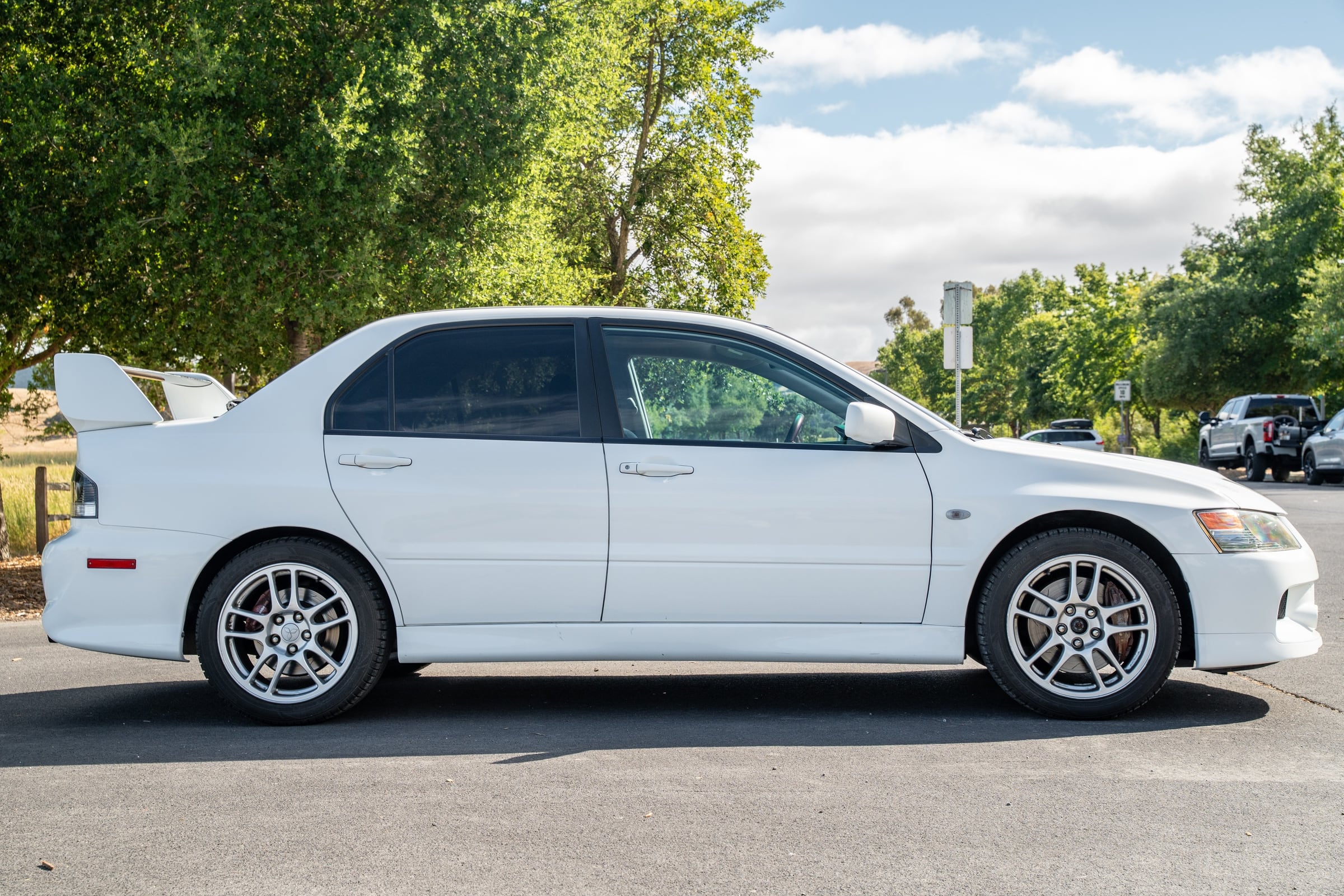
At the rear, the Evo 8's wing is carbon fiber reinforced plastic. The Evo 9's is a hollow carbon fiber spoiler, which Mitsubishi says lowers the center of gravity.
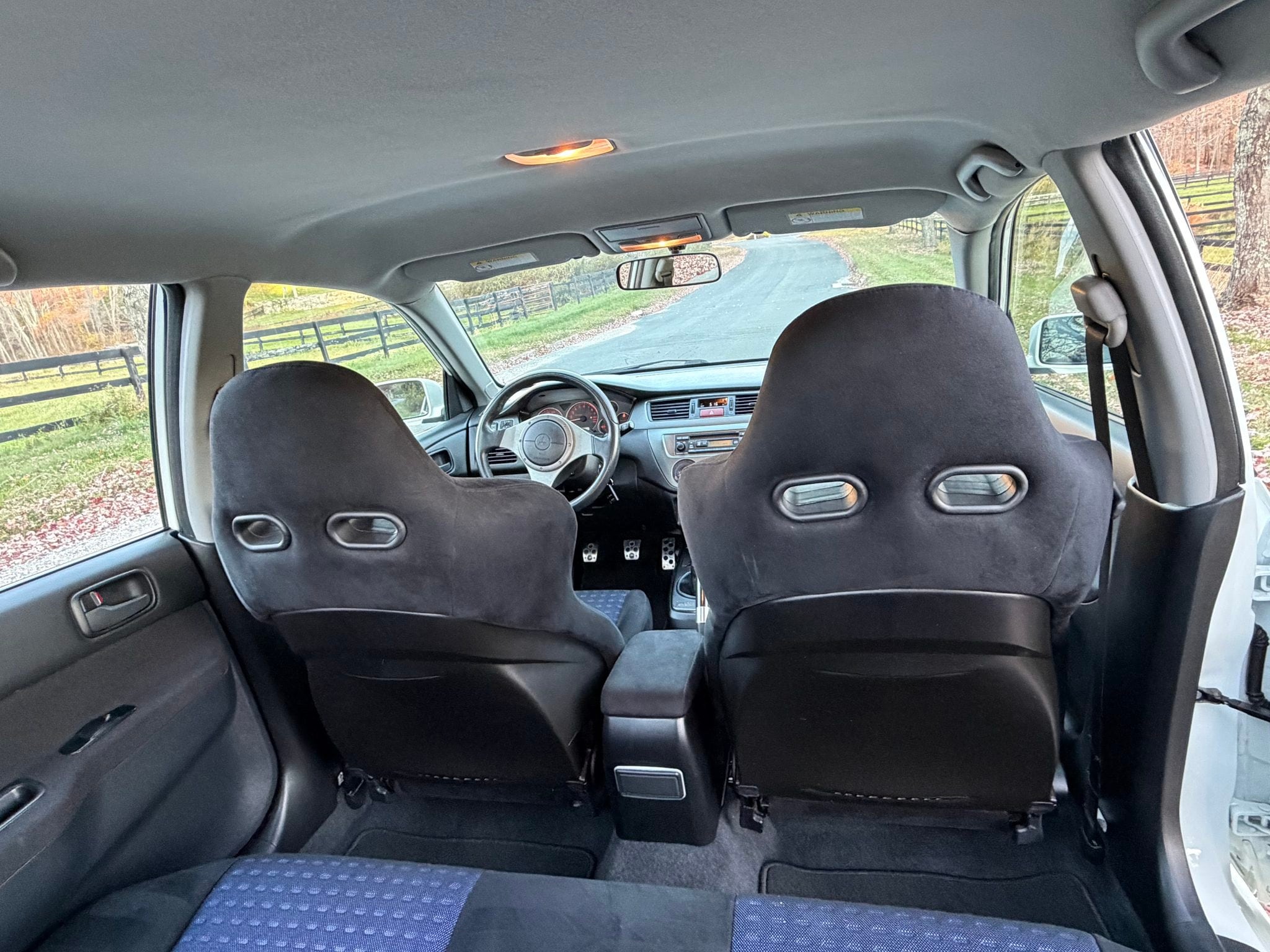
Inside, both cars have Recaro front seats and a three-spoke Momo steering wheel. The Evo 9's Recaros are trimmed in Alcantara, and its Momo wheel is a new dark design.
Trims: RS, MR and the six-speed
Both generations offer the stripped RS and the better-equipped MR alongside the standard car. The MR came first on the Evo 8, for 2005 only, with a six-speed gearbox, Bilstein shocks and an aluminum roof. Mitsubishi built 1,000 of them for the US.
The Evo 9 kept the MR and its six-speed, and late in 2006 added the SE. Our Evo MR article compares the MR across generations, and the Evo 9 MR article covers the 2006 car.
Performance when new
Period tests put the two cars close together. Each figure below is from one magazine's test of one car, so small gaps mean little.
| Test | 0 to 60 mph | Quarter mile | Base price |
|---|---|---|---|
| 2003 Evo 8, MotorWeek | 5.0 seconds | 13.8 seconds at 101 mph | $29,582 |
| 2006 Evo 9 MR, Jalopnik | 4.9 sec. | 13.7 sec. at 101 mph | $35,189 |
Car Throttle's ranking of the generations sums up the Evo 9 in one line: "Basically the Evo 8 but slightly better." The test numbers agree with that. The Evo 9 is an improvement in response and equipment more than in outright speed.
Which costs more now
The Evo 9 is the scarcer car, with 8,201 built for the US against 12,846 Evo 8s, and the market prices it higher.
| As of November 2026, this site's data | Evo 8 | Evo 9 |
|---|---|---|
| Cars for sale in the US | 127 | 62 |
| Median asking price | $26,000 | $32,000 |
| Median sale, last 6 months | $38,000 | $46,250 |
| Recorded sales, last 6 months | 7 | 10 |
The median sale sits above the median asking price for both cars because the recorded sales are mostly low-mileage auction cars, while the listings include high-mileage and modified ones.
Which to buy
The facts above point to three sensible choices.
- The lowest price for the CT9A chassis and the 4G63: a 2003 or 2004 Evo 8, accepting the viscous center differential.
- The Evo 9's drivetrain for less money: a 2005 Evo 8, with the ACD and 276 hp.
- MIVEC, the newer body and the stronger resale: an Evo 9.
From here, Evo VIII cars for sale and Evo IX cars for sale list what is on the market, and Evo values tracks what each generation sells for. The best Lancer Evo article weighs the Evo 9 against every rival.
Sources and photo credits (14)
- Supercars.net, 2003 Mitsubishi Lancer Evolution VIII, with Mitsubishi's launch text
- Supercars.net, 2005 Mitsubishi Lancer Evolution VIII MR, with Mitsubishi's announcement
- New Atlas, New Mitsubishi Lancer Evolution IX, with Mitsubishi's launch text
- Supercars.net, 2006 Mitsubishi Lancer Evolution IX
- Mitsubishi Motors North America, 2008 Lancer Evolution release
- Hagerty, on the Lancer Evolutions imported to the US
- MotorWeek, 2004 Subaru Impreza WRX STi vs 2003 Mitsubishi Lancer Evolution
- Jalopnik, 2006 Mitsubishi Lancer Evolution IX MR review
- Car Throttle, Mitsubishi Lancer Evolution history, generations and rankings
- Wikipedia, Mitsubishi Lancer Evolution
- Photo 1: 13k-Mile 2006 Mitsubishi Lancer Evolution IX, Bring a Trailer listing by 117033741z (photo 2006_mitsubishi_lancer_2006_mitsubishi_lancer_67b599b8-0909-4412-9377-ca44972002e5-4PSqo8-47092-47093)
- Photo 2: 36k-Mile 2005 Mitsubishi Lancer Evolution VIII MR, Bring a Trailer listing by UndrCvrEvo (photo IMG_3164-ff21dca98eb8d7a80aff39608d7d6a1e)
- Cover image: an illustration made with ChatGPT, not a photograph
- Articles page image: an illustration made with ChatGPT, not a photograph
For sale now
All Evo VIII and IX for sale

Register your Evo
Claim your VIN or chassis number. Your car gets a page with its photos, its ownership chapters and every sale on record.
Register your EvoPhoto: Bring a Trailer listing by Villarrs2418
Comments
Members can correct a mistake in this article or add to it here.
Log in or sign up free to comment.